Buying property in Portugal: everything you need to know in 2026

From finding the right location to signing the final deed, here’s what international buyers need to know

Portugal has become one of Europe’s most sought-after property markets, attracting buyers from across the world thanks to its climate, safety, lifestyle, infrastructure and relatively affordable property compared with many other Western European countries.

Whether you are looking for a holiday home, permanent residence, retirement property or investment opportunity, understanding how the Portuguese property market works is essential.

Can foreigners buy property in Portugal?

Yes.

Portugal places very few restrictions on foreign ownership of property. Buyers from the European Union, United Kingdom, United States, Canada and many other countries can purchase apartments, villas, townhouses, land and commercial property.

Foreign buyers enjoy the same ownership rights as Portuguese citizens.

Where are the most popular areas to buy?

The Algarve remains Portugal’s best-known international property market, particularly for lifestyle and retirement buyers.

Lisbon and Cascais continue to attract professionals, entrepreneurs and investors, while Porto has grown in popularity due to its vibrant culture and strong rental market.

Other emerging destinations include Comporta, the Silver Coast, Madeira and the Azores.

How much does property cost in Portugal?

Prices vary significantly by region.

Prime areas of Lisbon, Cascais, Quinta do Lago and Vale do Lobo command some of the highest prices in the country, while inland regions and smaller towns often offer considerably better value.

Buyers should carefully compare asking prices with recent market trends and local demand before making a purchase.

What additional costs should buyers expect?

When purchasing property in Portugal, buyers should budget for additional costs beyond the purchase price, including:

  • Property Transfer Tax (IMT)
  • Stamp Duty
  • Legal fees
  • Notary fees
  • Land Registry fees
  • These costs typically add several percentage points to the overall transaction value; a reasonable average is around 8%.

Should I use a lawyer?

Yes.

An independent lawyer can verify ownership, ensure there are no debts or legal issues attached to the property and oversee the transfer process.

This is one of the most important steps when buying property in Portugal.

Can foreigners obtain a mortgage?

Yes.

Many Portuguese banks offer mortgages to foreign buyers, although lending criteria, loan-to-value ratios and interest rates vary depending on the applicant’s circumstances.

Mortgage availability may differ for residents and non-residents.

Can property owners earn rental income?

Yes.

Portugal has an established holiday rental and long-term rental market.

However, regulations governing short-term holiday rentals have changed in recent years and buyers should seek professional advice regarding licensing requirements and local restrictions.

Is buying property in Portugal a route to residency?

Not automatically.

Although Portugal’s Golden Visa programme still exists, residential property purchases no longer qualify for the scheme.

Property ownership and residency should therefore be considered as separate matters.

Why is Portugal so popular with international buyers?

Portugal consistently ranks highly for quality of life, safety, healthcare, climate and political stability.

The country offers more than 300 days of sunshine in many regions, excellent transport links, beautiful coastlines and a welcoming international community.

For many buyers, Portugal represents a rare combination of lifestyle, investment potential and long-term security.

How does the buying process work?

The property purchase process in Portugal typically begins with an offer and negotiation. This is sometimes followed by a non-binding reservation agreement and refundable deposit. Once the deal is agreed, buyers then undertake legal due diligence, obtain a Portuguese tax number (NIF), and sign a Promissory Contract (CPCV), usually paying 10% (sometimes higher) of the purchase price. This deposit is not refundable, meaning that if the buyer backs out after signing the CPCV, they forfeit the deposit. On the other hand, if the vendor backs out, they must compensate the buyer by paying back double the amount of the deposit.

The transaction is completed at the final deed signing (Escritura) before a notary or lawyer, when the balance is paid and ownership is officially registered. The process generally takes between one and three months.

Article originally published on The Resident.

The complete guide to private hospitals in Portugal

Your essential guide to the country’s leading private hospitals and specialist medical care

Whether living permanently in Portugal or visiting for an extended period, patients have access to an extensive network of high-quality private healthcare. While hundreds of smaller clinics provide excellent local services, the country’s major private hospitals deliver comprehensive medical care, advanced technology and specialist expertise comparable with leading private hospitals elsewhere in Europe.

Several major healthcare groups dominate the sector, including CUF, Luz Saúde, Lusíadas Saúde, Hospital da Luz and Trofa Saúde, alongside a number of respected independent hospitals. Together they provide comprehensive healthcare coverage across mainland Portugal, Madeira and the Azores.

For many foreign residents, private health insurance remains an affordable way to access faster appointments, shorter waiting times and a broader choice of specialists.

This guide highlights the country’s principal private hospitals region by region.

North

Hospital da Luz Guimarães – Guimarães
A leading private healthcare provider in the Minho region, Hospital da Luz Guimarães offers urgent care, surgery, diagnostic imaging, physiotherapy, specialist consultations and day-case procedures. It provides comprehensive medical services for both local residents and patients from across northern Portugal.

CUF Porto Hospital – Porto
One of northern Portugal’s leading private hospitals, offering emergency care, surgery, diagnostics, oncology, cardiology, orthopaedics and maternity services, supported by modern technology and highly specialised medical teams.

Hospital da Luz Arrábida – Vila Nova de Gaia
Serving the Porto metropolitan area, offering emergency care, surgery, diagnostics, oncology, paediatrics, maternity services and specialist outpatient consultations.

Lusíadas Porto Hospital – Porto
Part of the Lusíadas Saúde network, offering emergency care, surgery, diagnostics, specialist consultations and patient-focused services in a modern setting.

Trofa Saúde Hospital Vila Real – Vila Real
Serving the Trás-os-Montes region, offering emergency care, surgery, diagnostics, maternity services and specialist medical consultations.

Trofa Saúde Braga Sul – Braga
A major private healthcare provider for the Braga region, offering emergency care, surgery, diagnostics, rehabilitation services and specialist outpatient consultations.

Hospital Privado de Braga – Braga
This independent private hospital offers emergency care, surgery, diagnostics, cardiology, orthopaedics and specialist consultations.

Trofa Saúde Alfena Hospital – Valongo
Serving communities east of Porto, offering emergency care, surgery, diagnostics, outpatient services and specialist consultations.

Central Portugal

Hospital CUF Coimbra – Coimbra
One of central Portugal’s newest major private hospitals, offering emergency care, surgery, diagnostics, oncology, cardiology and multidisciplinary specialist consultations.

Hospital da Luz Coimbra – Coimbra
Offering emergency care, surgery, diagnostics, imaging services and specialist consultations across a wide range of medical disciplines.

Lusíadas Hospital Santa Maria da Feira – Santa Maria da Feira
Serving the Aveiro district, offering emergency care, surgery, diagnostics, maternity services and specialist consultations.

Hospital CUF Viseu – Viseu
A modern regional hospital offering emergency care, surgery, diagnostics, physiotherapy services and specialist consultations.

Hospital CUF Leiria – Leiria
Serving Leiria and the surrounding central region, Hospital CUF Leiria offers 24-hour urgent care, surgery, diagnostic imaging, physiotherapy, specialist consultations and day procedures. As part of the CUF network, it provides modern facilities and multidisciplinary care across a broad range of medical specialties.

Hospital do Oeste Soerad – Torres Novas
An established independent private hospital offering emergency care, surgery, diagnostics, rehabilitation services and specialist consultations.

Lisbon and surrounding area

Hospital da Luz – Lisbon
One of Portugal’s best-known private hospitals, Hospital da Luz Lisboa offers a wide range of specialist consultations, diagnostics, surgery and urgent care, with strong international patient support.

Hospital CUF Tejo – Lisbon
A flagship CUF hospital in Lisbon, CUF Tejo is a modern private facility offering advanced diagnostics, surgery, specialist medicine, paediatrics and multidisciplinary care.

Hospital CUF Descobertas – Lisbon
Located in Parque das Nações, CUF Descobertas is one of Lisbon’s established private hospitals, known for broad medical services, surgery, imaging and 24-hour permanent care.

Hospital Lusíadas – Lisbon
A leading central Lisbon private hospital, Lusíadas Lisboa offers specialist consultations, diagnostics, surgery and agreements with major insurers and health subsystems.

Hospital Cruz Vermelha – Lisbon
Hospital Cruz Vermelha is a long-established Lisbon hospital offering more than 35 specialties, non-scheduled care and agreements with ADSE and major insurers.

Hospital da Luz – Oeiras
Serving the western Lisbon area, Hospital da Luz Oeiras offers consultations, exams, surgery and urgent care, with modern facilities and access to the wider Luz Saúde network.

Hospital CUF – Cascais
A major private hospital for Cascais and the Lisbon coast, CUF Cascais provides a broad range of specialties, diagnostics, surgery and permanent care services.

Hospital CUF Sintra – Sintra
One of CUF’s newest private hospitals, Hospital CUF Sintra provides 24-hour urgent care, advanced diagnostics, surgery, cardiology, orthopaedics, paediatrics and specialist consultations. Designed with state-of-the-art facilities, it serves the growing communities of Sintra and Greater Lisbon.

Hospital Lusíadas Amadora – Amadora
Serving Amadora and the western Lisbon metropolitan area, Hospital Lusíadas Amadora provides urgent care, surgery, advanced diagnostic imaging, specialist consultations and outpatient services across a wide range of medical specialties. As part of the Lusíadas Saúde network, it offers modern facilities and coordinated patient care.

Hospital da Luz Setúbal – Setúbal
Serving Setúbal and the surrounding peninsula, Hospital da Luz Setúbal offers urgent care, surgery, diagnostic imaging, oncology, cardiology, orthopaedics and specialist outpatient consultations. As part of the Luz Saúde network, it combines modern technology with multidisciplinary medical care.

Alentejo

Hospital da Misericórdia de Évora – Luz Saúde – Évora
Hospital da Misericórdia de Évora – Luz Saúde is a modern private hospital offering multidisciplinary healthcare, advanced diagnostics, surgery, emergency care and specialist services to patients across Alentejo.

Hospital CUF Alentejo – Sines
Part of Portugal’s largest private healthcare group, CUF Alentejo provides modern diagnostic services, day surgery, specialist consultations, imaging, physiotherapy and multidisciplinary medical care.

Hospital São João de Deus – Montemor-o-Novo
An established independent hospital providing surgery, rehabilitation, diagnostic imaging, outpatient consultations and specialist medical services for central Alentejo communities.

Algarve

Hospital CUF Descobertas – Faro
One of southern Portugal’s leading private hospitals, offering a 24-hour emergency department, advanced surgery, oncology, cardiology, maternity services, intensive care, diagnostics and numerous specialist medical services.

Lusíadas Faro Hospital – Faro
A modern private hospital offering emergency care, surgery, advanced imaging, oncology, cardiology, maternity services and a wide range of specialist consultations, serving both local residents and international patients.

Hospital de Loulé – Loulé
An independent private hospital providing surgery, outpatient consultations, diagnostic imaging, physiotherapy, day procedures and specialist medical services to central Algarve communities.

Hospital Lusíadas – Albufeira
Serving the central Algarve, Hospital Lusíadas Albufeira provides specialist consultations, diagnostic imaging, outpatient surgery and urgent care. As part of the Lusíadas Saúde network, it offers modern facilities and coordinated access to a broad range of medical specialties for both residents and international visitors.

Hospital CUF Alvor – Portimão
Serving the western Algarve, this modern hospital provides emergency medicine, surgery, imaging, orthopaedics, cardiology, physiotherapy and specialist consultations for residents and visitors.

Hospital São Camilo – Portimão
Located in Portimão, Hospital São Camilo is a long-established private hospital providing inpatient care, surgery, specialist consultations and diagnostic services. It serves residents across the western Algarve and complements the region’s larger private hospital networks with a more local, community-focused approach.

Madeira

Hospital CUF Madeira – Funchal
Madeira’s largest private hospital provides 24-hour emergency care, advanced surgery, diagnostic imaging, cardiology, oncology, orthopaedics, maternity services and a wide range of specialist outpatient consultations for residents and visitors.

Clínica de Santa Luzia – Funchal
One of Madeira’s longest-established private medical centres, offering specialist consultations, diagnostic imaging, physiotherapy, outpatient surgery and day-case procedures across numerous medical disciplines.

Hospital da Luz Madeira – Funchal
Part of the Hospital da Luz network, this modern private hospital offers emergency medicine, surgery, advanced diagnostics, cardiology, orthopaedics and specialist medical consultations in contemporary facilities.

Azores

Hospital CUF Açores – Lagoa, São Miguel
The Azores’ leading private hospital provides 24-hour urgent care, surgery, inpatient care, intensive care, advanced diagnostic imaging and more than 20 medical and surgical specialties. Serving patients from across the archipelago, it forms part of the nationwide CUF healthcare network.

Clínica do Bom Jesus – Ponta Delgada, São Miguel
A respected private medical clinic providing specialist consultations, diagnostic services, physiotherapy, imaging and minor surgical procedures for residents and visitors alike.

Casa de Saúde de Nossa Senhora da Conceição – Angra do Heroísmo, Terceira
Serving Terceira Island, this long-established private healthcare facility provides specialist consultations, diagnostics, rehabilitation services, day surgery and a range of outpatient medical treatments.

Article originally published on The Resident.

Healthcare in Portugal explained for foreign residents

Thinking of moving to Portugal? Here’s how the country’s public and private healthcare systems work, what treatment costs to expect and how foreign residents can access care

Healthcare is one of the most important factors to consider when relocating to another country. Whether you are moving to Portugal for work, retirement, business, investment, study or simply a change of lifestyle, understanding how the healthcare system works can provide valuable peace of mind.

Fortunately, Portugal is widely regarded as having one of Europe’s strongest healthcare systems. The country combines a comprehensive public healthcare network with a growing private sector, giving residents access to a broad range of medical services at relatively affordable costs.

Does Portugal have public healthcare?

Yes.

Portugal operates a national healthcare system known as the Serviço Nacional de Saúde (SNS), which provides healthcare services to legal residents throughout the country.

Once registered, residents can generally access a wide range of healthcare services, including:

  • General practitioner (GP) appointments
  • Specialist consultations
  • Hospital treatment
  • Emergency care
  • Maternity services
  • Preventative healthcare programmes
  • Mental health services

The SNS is funded primarily through taxation, making healthcare significantly more affordable than in countries such as the USA. While some services may involve small user fees, the cost of treatment is generally heavily subsidised.

Is private healthcare available?

Yes.

Alongside the public system, Portugal has an extensive network of private hospitals, clinics and specialist medical centres.

Many foreign residents choose to combine access to the public healthcare system with private health insurance, allowing them to benefit from both sectors.

Private healthcare is particularly popular because it usually offers:

  • Shorter waiting times
  • Greater flexibility when choosing doctors and specialists
  • Modern facilities and equipment
  • Convenient appointment scheduling
  • Better access to English-speaking medical professionals

Major cities such as Lisbon, Porto and Faro, as well as popular international destinations throughout the Algarve, are home to numerous high-quality private healthcare providers.

How much does healthcare cost?

Healthcare costs in Portugal are generally considered reasonable by European standards.

The public healthcare system provides access to essential medical services mostly free of charge or at relatively low cost, while private health insurance remains considerably more affordable than in many other developed countries.

As a guide, comprehensive private health insurance for an adult may range from approximately €800 to €2,500 per year depending on age, medical history, coverage levels and provider.

Consultations with private doctors typically cost between €60 and €120, while specialist appointments may cost slightly more.

Prescription medicines are also often subsidised by the state, helping to reduce out-of-pocket expenses.

Are English-speaking doctors available?

Yes.

English-speaking doctors and healthcare professionals are widely available, particularly in areas with significant international communities.

Many private hospitals and clinics actively cater to foreign residents and international patients, while an increasing number of healthcare professionals within the public system also speak English.

In addition to English, it is often possible to find medical professionals who speak French, German, Dutch and other European languages.

What about emergency care?

Portugal provides a comprehensive emergency medical service.

Residents can access emergency departments at public and private hospitals, while the national emergency number 112 connects callers to ambulance, police and fire services.

Emergency care standards are generally high, particularly in urban areas and major population centres. It is important to note that when dialing 112 in a medical emergency, the ambulance will always take the patient to a state hospital where treatment will be administered. If a patient wishes to then move to a private hospital this is possible but the patient must assume the cost of a private ambulance if required.

Is healthcare one of Portugal’s advantages?

For many people, the answer is yes.

Healthcare is frequently cited as one of the reasons foreign nationals choose Portugal as their new home. Combined with the country’s safety, climate, high quality of life, modern infrastructure and welcoming international communities, access to reliable healthcare adds to Portugal’s appeal as a destination for relocation.

Whether moving alone, as a couple or with a family, understanding the healthcare options available before arriving can help ensure a smoother transition and greater confidence when starting a new life in Portugal.

Article originally published on The Resident.

Moving to Portugal in 2026? Here’s what life really costs

The days of ultra-cheap living may be over, but Portugal remains an attractive option for many international residents

For years, Portugal was sold abroad as one of Europe’s last great bargains – a place where sunshine, good food and a relaxed pace of life could be enjoyed for a fraction of the cost of living in London, San Francisco or Scandinavia.

And to some extent, that remains true.

A coffee can still cost less than €1 in some cafés. A leisurely lunch in a local restaurant needn’t break the bank and fresh fish, fruit and vegetables continue to represent good value. But in 2026, the reality is rather more nuanced.

Portugal can still offer excellent value compared with many parts of the UK, the United States and Northern Europe, yet rising housing costsinflation and changing lifestyles mean newcomers need a more realistic understanding of what everyday life actually costs.

The answer depends largely on where you choose to live.

Real estate

Housing remains by far the biggest factor influencing the cost of living. Lisbon continues to be Portugal’s most expensive city, followed by sought-after areas such as Cascais, parts of the Silver Coast and many locations in the Algarve. Porto remains somewhat more affordable than the capital, although prices there have risen considerably over the past few years.

The Algarve perhaps best illustrates Portugal’s growing regional divide. Prime areas such as Quinta do LagoVale do LoboVilamouraLagos and Carvoeiro now command prices that would have seemed unimaginable a decade ago. Yet move inland to places such as São Brás de Alportel, Monchique or parts of the eastern Algarve and costs can fall dramatically.

Elsewhere, the Silver Coast continues to attract buyers seeking a balance between lifestyle and affordability. Areas around ÓbidosCaldas da Rainha and Nazaré remain popular, although increasing international demand means prices are often higher than many newcomers expect.

Madeira has experienced a similar trend. The island’s popularity with digital nomads, foreign residents and international investors has pushed property values upwards, particularly in and around Funchal. The Azores generally remain among Portugal’s more affordable regions, although the additional cost of transporting goods to the islands means some everyday purchases can be more expensive than on the mainland.

Food prices

Food prices have also changed. Portugal’s supermarkets still compare favourably with many countries in Western Europe, particularly when buying local fruit and vegetables, fresh fish and seasonal produce. Imported foods, international brands and convenience items, however, have all seen noticeable increases.

Eating out remains one of Portugal’s enduring strengths. A traditional prato do dia (dish of the day) in a neighbourhood restaurant can still represent excellent value, while cafés continue to offer inexpensive coffee and pastries. In tourist hotspots, however, prices increasingly reflect international demand rather than local purchasing power.

Utilities

Utilities are another expense many relocation guides gloss over. Electricitywaterinternet and mobile services remain reasonable by European standards, but air conditioning during increasingly hot summers and heating in winter can substantially increase bills, especially in older properties with poor insulation.

Transportation

Transport costs are also worth considering. While public transport networks in Lisbon and Porto are relatively affordable, many residents in smaller towns, rural areas, Madeira and the Azores depend heavily on private vehicles. Fuelinsurancetollsmaintenance and annual inspections can quickly add up.

Healthcare

Healthcare remains one of Portugal’s major attractions. Residents have access to the public healthcare system (SNS), while many also choose private health insurance to secure faster appointments and greater flexibility.

Although private healthcare is generally affordable by international standards, it should still form part of any realistic monthly budget.

Read out dedicated guide to healthcare in Portugal.

Context matters

Seen in this context, Portugal still represents good value for many international residents. However, the days when newcomers could expect a near-Mediterranean lifestyle on a modest budget in every part of the country are largely behind us. Increasingly, affordability depends not only on income, but also on being flexible about where in Portugal you choose to live.

There are also a number of less obvious costs that many relocation articles fail to mention. Condominium feesproperty maintenanceIMI council property tax, legal feesresidency applicationsdocument translationsvehicle registration expenses and private schooling can all have a significant impact on annual spending.

So what does comfortable living actually cost?

A single person renting in Lisbon, Porto, Madeira or a popular Algarve location may easily require between €1,800 and €2,500 per month to maintain a comfortable lifestyle. Couples often benefit from economies of scale, while homeowners and those living away from the most sought-after areas may spend considerably less.

Portugal undoubtedly remains one of Europe’s most attractive destinations for those seeking safety, climate, healthcare and quality of life. But successful relocation increasingly depends on matching expectations with reality.

For anyone considering moving to Portugal in 2026, the most important question is no longer whether the country is cheap. It is whether the lifestyle, location and budget are the right fit for you.

Article originally published on The Resident.

Houston, we had a problem!

American couple Mike and Neidre traded U.S. healthcare costs and stress for a simpler life on Portugal’s Setúbal coast

When Mike and Neidre Via left Houston, Texas, for Setúbal, Portugal, they carried three suitcases, each with a backpack, and the determination to start over. Their move, guided by Calvin Mazlumyan of Plan B Outbound Migration and his partner law firm in Portugal, was driven by two main factors: financial reality and the search for a healthier, less stressful life.

At 66, Mike was ready to stop working. In the U.S., that didn’t seem possible. Even with Social Security, both would have needed jobs just to cover basic expenses — especially healthcare.

“If we were to stay in the States, we’d both have to work,” Mike says. “And I am done.” The risk of a major illness wiping out their savings weighed heavily on him.

For 52‑year‑old Neidre, there was also a health dimension. She was born with asthma and struggled in Houston’s polluted, car‑dependent environment, needing inhalers and pills daily. But trips to Italy in 2022 and Tenerife in 2023 changed her perspective. Days spent biking in the Dolomites and a week by the sea in the Canary Islands passed without a single asthma attack.

Europe seemed kinder to her lungs — and to their lifestyle. When Mike’s company offered early retirement in 2024, their vague plan to “move to Europe someday” suddenly felt urgent. If they stayed in the U.S., Neidre would have to work another 15–20 years before she could retire. Instead, they began looking at Portugal, a country they knew only from a surfing documentary about Nazaré.

Their first visit in July 2024 took them from Lisbon to Porto, then down to Nazaré, and finally to Faro in the Algarve. They travelled entirely by public transport to test whether they could live without a car. By the time they flew home, the decision was clear: they wanted to leave the U.S. by the end of 2025.

Through an online “move abroad” programme, they learned about the “Living in Portugal” seminar in Houston that April — the only one scheduled there for two years. There, they met Calvin Mazlumyan of Plan B Outbound Migration. Within that hour, they realised they needed professional help to navigate Portugal’s visa and residency system.

Calvin and his Portuguese partner law firm, NSM, handled the logistics: opening a Portuguese bank account, creating detailed document checklists, and booking their VFS visa appointment (the earliest available was October 30). The lawyers’ eye for detail proved crucial. They caught that the couple’s rental contract in Portugal was for one year, not the two years required for residency, and had it corrected. They also flagged the need for an apostille on their marriage certificate, prompting a same‑day dash from Houston to Austin to get it in time.

Timing was everything. Many documents must be issued within 30–90 days of the appointment. Without expert guidance, Mike and Neidre admit they would have missed key deadlines.

The biggest shock came when Mike’s FBI background check flagged a minor, decades‑old issue dating back to 1997. Their visa was initially denied. With only about two weeks to appeal and Thanksgiving looming, NSM drafted a legal appeal, told them exactly what proof to gather, and resubmitted the file. The appeal succeeded. On December 31, their visas were approved; on January 19, they landed in Portugal — just as Storm Ingrid hit.

They had already committed to Setúbal, a city they had never visited but chose strategically. Coming from Greater Houston’s four million people, they didn’t want to jump into a village of a few thousand. Setúbal offered urban energy, hospitals, a strong public transport network, and nearby beaches. Lisbon is just 40–50 minutes away by frequent train.

With the help of a local estate agent referred by Neidre’s realtor sister, they rented a fully furnished three‑bed, two‑bath apartment near Praça do Brasil, opposite the train station. The landlord, who lives in Tróia, had stocked it with dishes and cleaning supplies. After selling or giving away all their belongings in Houston — cars, furniture, even hundreds of souvenir shot glasses — they arrived with only clothes and essentials.

Life in Setúbal has settled into a gentle rhythm. Their building is mostly home to older Portuguese residents; few speak English. There’s a café downstairs and several more within a block. They bought bikes, joined a gym about 2 km away, and organised their days around workouts, grocery trips, beach outings, castle visits, and evenings with wine at local cafés. The regulars now bring them snacks and chat; they, in turn, are learning Portuguese phrase by phrase, with help from Google Translate and their neighbours’ patience.

They’ve made a deliberate choice to avoid expat meetups. “We want to be part of the Portuguese culture,” says Neidre. As a Black American woman with natural hair, she’s often assumed to be Brazilian or Angolan and addressed in Portuguese. Mike is often mistaken for a European. These assumptions, combined with daily immersion, are slowly improving their language skills.

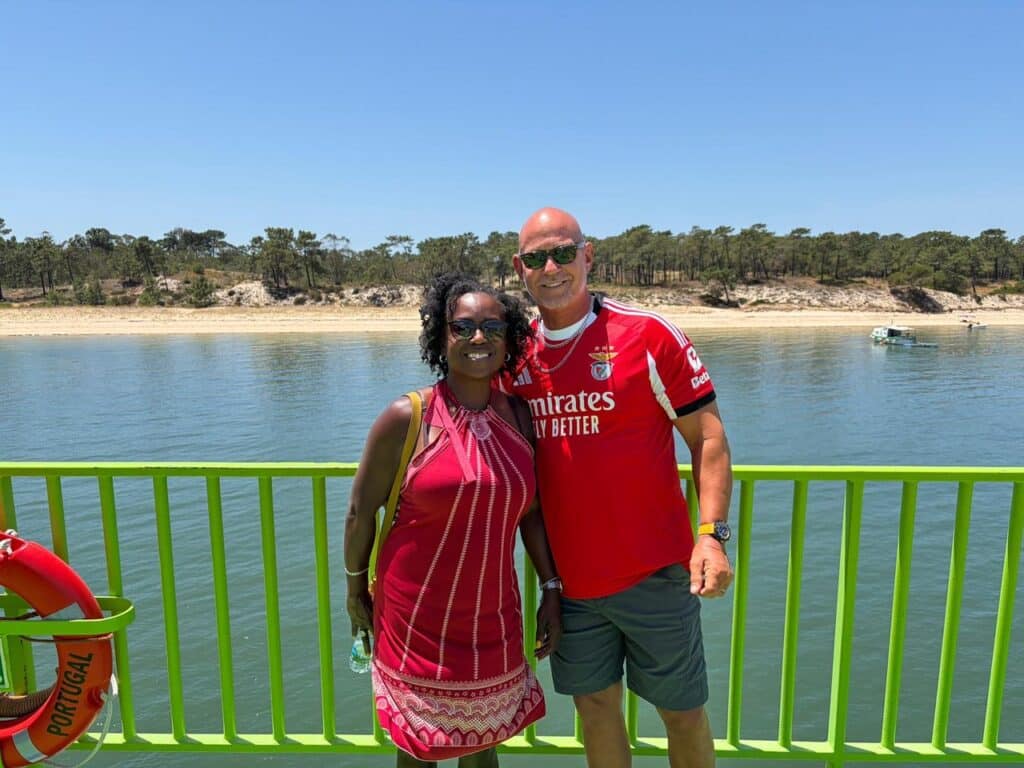
American couple Mike and Neidre

Looking back, both say they wish they had moved earlier — but they’re clear that without Calvin and Plan B Outbound Migration, the move might never have happened. From correcting leases and tracking expiry dates to drafting a time‑critical legal appeal, the support they received transformed a daunting bureaucracy into a solvable puzzle.

Today, the soundtrack of their lives is no longer Houston traffic and hold music from insurance companies. It’s the clatter of coffee cups downstairs, the whistle of the train across the street, and the sea breeze on the promenade. When Calvin visited recently, he told them they looked like different people — lighter, younger, and completely at ease.

They came for lower costs and better healthcare. They stayed for something they hadn’t quite planned on: lazy afternoons at the café, bikes instead of cars, neighbours who bring wine and peanuts to the table — and the delicious realisation that, somehow, this “Plan B” has become the life they were looking for all along.

Article originally published on The Resident.

Complete guide to Portuguese residency in 2026

Complete guide to Portuguese residency in 2026

From retirement visas to digital nomad permits and investment routes, here’s what foreign nationals need to know about moving to Portugal in 2026

Portugal remains one of Europe’s most attractive destinations for people seeking a better quality of life, a warm climate, excellent healthcare, political stability and access to the European Union. As a result, thousands of foreigners relocate to Portugal every year.

But what are the available routes to Portuguese residency in 2026, and which visa is right for you?

Who needs a visa to move to Portugal?

Citizens of European Union and European Economic Area countries generally have the right to live and work in Portugal with relatively few formalities.

For non-EU citizens, including British, American, Canadian, Australian and South African nationals, a visa is usually required before applying for residency.

Portugal offers a range of visa options designed to accommodate retirees, remote workers, entrepreneurs, investors, employees and family members.

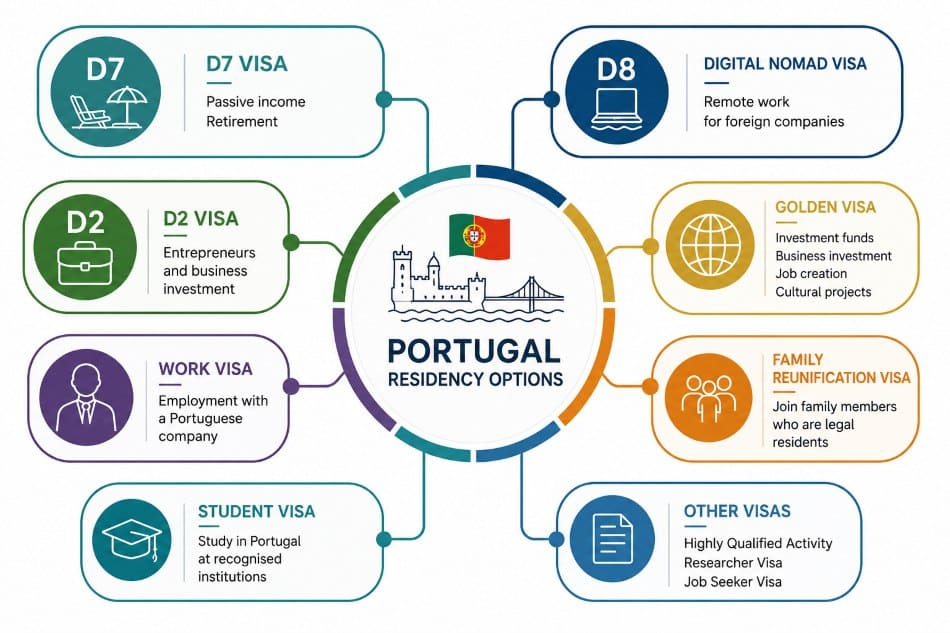
The D7 Visa: Portugal’s retirement and passive income visa

The D7 Visa remains one of Portugal’s most popular residency routes.

It is designed for individuals who have sufficient passive income to support themselves without needing employment in Portugal. Sources of income may include pensions, rental income, dividends, investment returns or royalties.

The D7 is particularly popular with retirees and financially independent individuals seeking to relocate permanently to Portugal.

The Golden Visa

Portugal’s Golden Visa remains available in 2026, although significant changes have been introduced.

Residential and commercial property purchases no longer qualify for the programme.

Current qualifying routes generally focus on:

  • Investment funds
  • Business investment
  • Job creation
  • Scientific research
  • Cultural heritage projects

The Golden Visa remains attractive because it requires relatively limited physical presence in Portugal while still providing a route towards permanent residency and citizenship. Also, unlike the other visas the applicant need not become a Portuguese tax resdient, as long as they do not spend more than 183 days per year in the countty.

The Digital Nomad Visa

Introduced in response to the growing remote working trend, Portugal’s Digital Nomad Visa (the D8) allows foreign nationals employed by overseas companies or operating their own businesses remotely to live in Portugal.

Applicants must meet minimum income requirements and demonstrate that their work is carried out for clients or employers outside Portugal.

The visa has become especially popular among technology professionals, consultants and online entrepreneurs.

The D2 Visa: Portugal’s entrepreneur and investment visa

The D2 Visa is one of the most flexible routes to Portuguese residency.

Designed for entrepreneurs, business owners and independent professionals, it allows applicants to establish or invest in a business in Portugal.

Unlike the Golden Visa, there is no fixed minimum investment amount. Instead, applicants must demonstrate that their proposed business activity is viable and has the potential to contribute to the Portuguese economy.

The D2 is commonly used by:

  • Entrepreneurs launching a Portuguese company
  • Existing business owners expanding into Portugal
  • Consultants and freelancers
  • Small business investors

For many applicants, the D2 Visa offers one of the most accessible pathways to residency through business activity.

Work visas

Individuals who have secured employment with a Portuguese company may apply for a work visa (the D1).

The employer typically plays a key role in supporting the application process.

Portugal continues to attract skilled workers in sectors such as technology, healthcare, engineering, tourism and hospitality.

Highly Qualified Activity (HQA) and specialist routes

Portugal offers additional residency pathways for highly qualified professionals, researchers, academics and individuals involved in innovation-related activities.

These programmes are designed to attract talent and support economic growth.

Eligibility depends on professional qualifications, experience and the nature of the proposed activity.

Lisbon – Photo: Louis Droege/Unsplash

Student visas

Foreign nationals enrolled in recognised Portuguese educational institutions may apply for student residency permits.

These visas are popular with university students, postgraduate researchers and individuals undertaking specialised training programmes.

Family reunification

Portugal allows qualifying family members of legal residents to apply for residency through family reunification.

Spouses, dependent children and, in some circumstances, dependent parents may be eligible.

This route is widely used by expatriates who initially relocate alone and later bring family members to Portugal.

How long does residency last?

Most initial residence permits are granted for two years and can subsequently be renewed.

After five years of legal residency, many foreign residents become eligible to apply for permanent residency.

Can residents access healthcare?

Yes.

Legal residents generally have access to Portugal’s public healthcare system, known as the SNS.

Many expatriates also choose private health insurance to gain faster access to specialists and private hospitals.

What about taxes?

Tax residency and immigration residency are not necessarily the same thing.

Anyone planning to relocate should obtain professional tax advice before moving, particularly if they have overseas assets, pensions, businesses or investments.

Portugal remains attractive from a taxation perspective for many individuals, but the rules vary depending on personal circumstances.

Is Portuguese citizenship possible?

For many foreigners, obtaining Portuguese citizenship is the long-term objective.

After ten years of legal residency, applicants may be eligible to apply for citizenship, subject to meeting language and other legal requirements.

Portuguese citizenship provides the right to live, work and travel freely throughout the European Union.

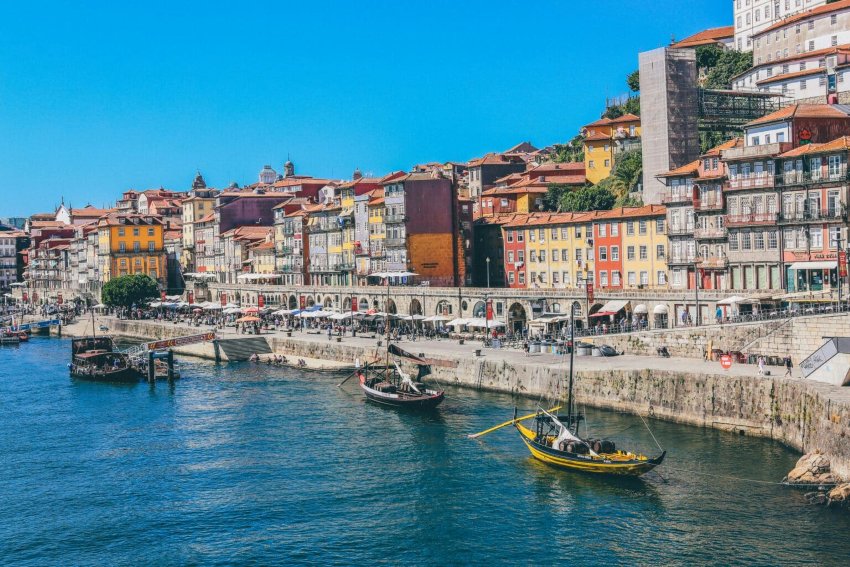
Porto – Photo: Nick Karvounis/Unsplash

Which visa is best?

The answer depends entirely on your circumstances.

  • Retirees often favour the D7 Visa.
  • Remote workers frequently choose the Digital Nomad Visa.
  • Entrepreneurs and business owners commonly use the D2 Visa.
  • Investors may consider the Golden Visa.
  • Employees generally require a work visa.
  • Students can apply for student residency permits.

Portugal’s wide range of residency options means there is a suitable pathway for almost every type of applicant.

For anyone considering a move to Portugal in 2026, understanding these residency routes is the first step towards building a successful life in one of Europe’s most popular destinations.

Article originally published on The Resident.